Who it's for
- Unmarried couples, friends or family members buying together, especially with unequal deposits
- Co-owners of a buy-to-let or investment property
- Both owners should take independent legal advice before signing
What's included
- About this document and a legal advice warning
- Parts 1 and 2 — property and owner details
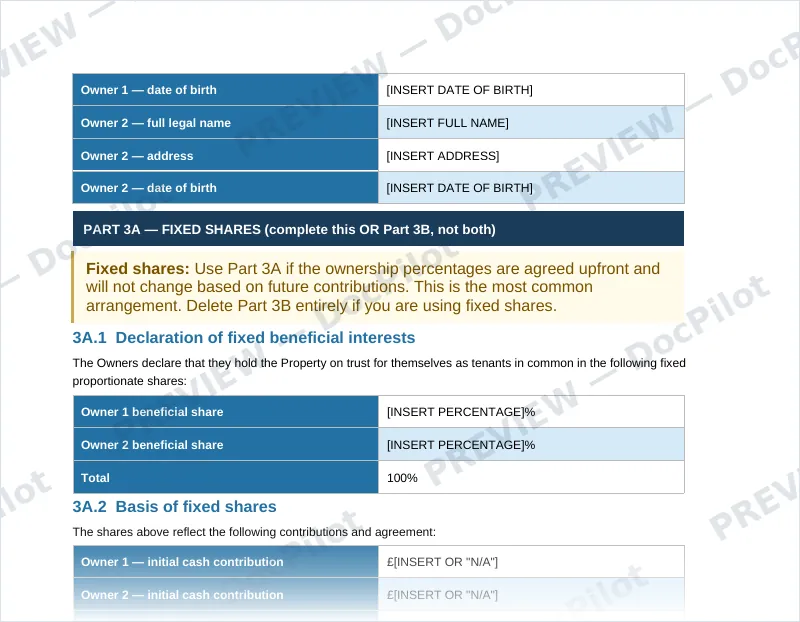
- Part 3A — Fixed shares or Part 3B — Floating shares, with a formula and rules for qualifying contributions
- Part 4 — proceeds of sale and costs
- Part 5 — first refusal and buy-out
- Part 6 — occupation or rental income
- Part 7 — death, no survivorship and the Land Registry Form A restriction
- Part 8 — variation, disputes and severance; Part 9 — execution as a deed
Key points covered
- Tenants in common have no right of survivorship — each share passes under the owner's will or intestacy
- Floating shares count initial cash, mortgage capital repayments and agreed improvements; interest and routine costs do not count
- Right of first refusal at open market value, with 30 days to accept
- Apply to HM Land Registry for a Form A restriction
- Signed as a deed in front of an independent witness
DocPilot templates are drafted from current legislation and official guidance (GOV.UK, legislation.gov.uk and the relevant regulators), checked against those sources and fully re-reviewed every six months. They are not legal advice. How we make our documents →
Read the guide
Related documents
Cohabitation Agreement£16.99 · See what's included →Separation Agreement£19.99 · See what's included →Standard Will Template£19.99 · See what's included →
Questions
Fixed or floating shares — which should we use?
Fixed shares suit owners who agree percentages up front. Floating shares suit owners whose contributions will differ over time, for example where one pays more of the mortgage.
Does it change who owns the property at the Land Registry?
No. It records your beneficial shares. Apply for a Form A restriction, and ask your conveyancer about the legal title.
What happens if one of us dies?
As tenants in common there is no survivorship — each share passes under the owner's will, so both of you should make or update a will.
Do we need a solicitor?
Independent legal advice is strongly recommended for both owners.
Declaration of Trust
£16.99 · Word + PDF · instant download
Buy — £16.99 →Bought the wrong document by genuine mistake? Our Swap or Refund Promise lets you swap it or get a refund within 14 days.